Blog
Top 10 Races in One Piece for Your Next Adventure
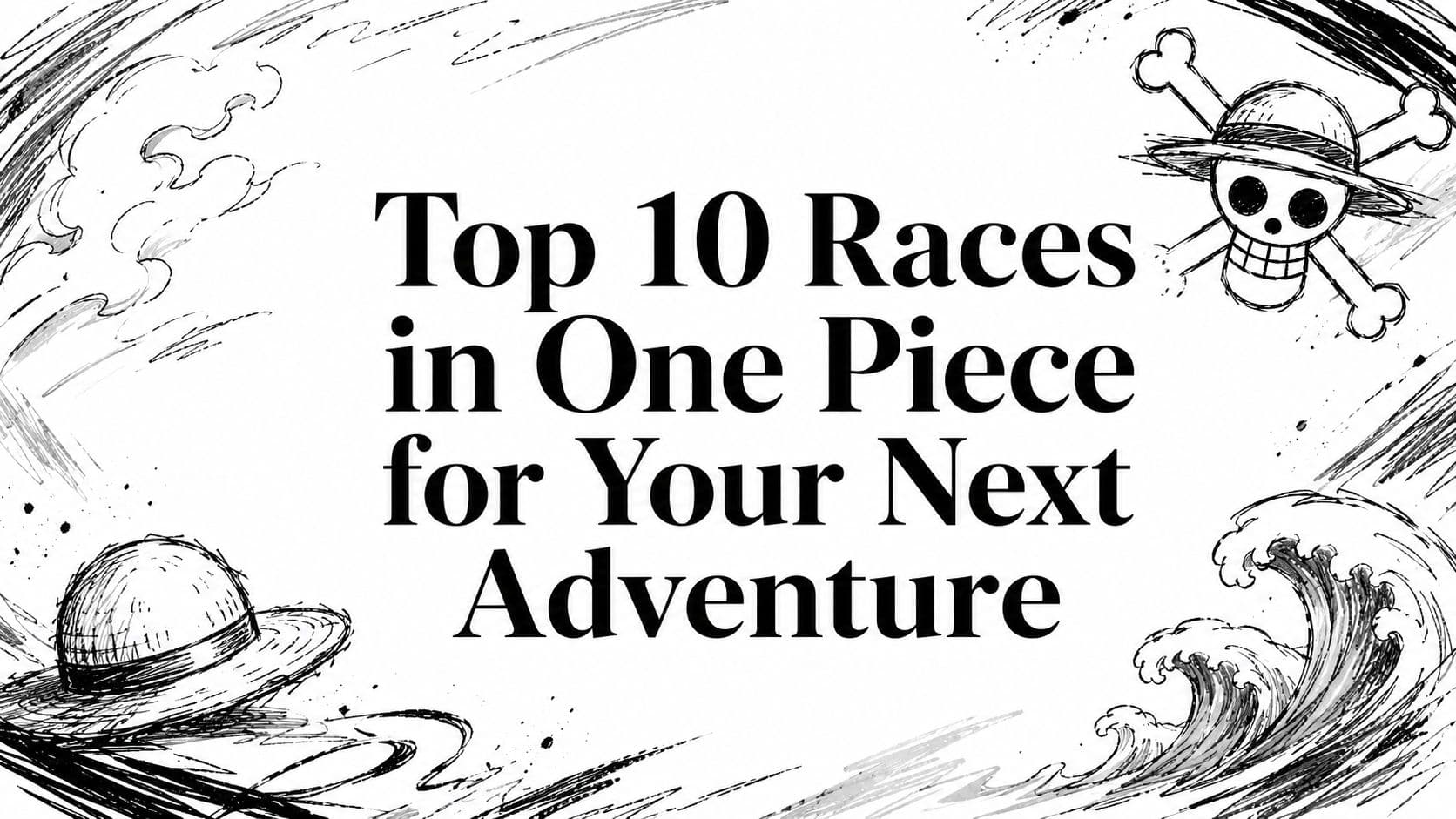
The Grand Line is a melting pot of cultures. The sheer variety of races in One Piece is what keeps this world feeling alive. From towering Giants to electric Minks, every species brings something unique to the table.
We've rounded up the major races you need to know about. Their abilities, their histories, and how they fit into the larger world. Whether you're building a new character for an interactive story on the platform or fleshing out your own worldbuilding project, this list gives you the raw material to work with.
What you'll find here:
- Canonical and playable species from the One Piece universe
- Notable characters and typical traits for each race
- Creative prompts for integrating them into your own narratives
Let's jump in.
1. Humans
Humans dominate the world of One Piece in sheer numbers and influence. They lack the built-in advantages of other races. Yet they consistently rise to the top through sheer willpower, tactical thinking, and relentless training. When exploring the many races in One Piece, humans stand out precisely because they have no special biology to fall back on. Everything they achieve is earned.

What Makes Humans Unique
- No innate supernatural traits - every skill is learned or acquired
- Access to Devil Fruits - humans can consume these to gain extraordinary powers
- Mastery of Haki - the spiritual energy system available to any human who trains hard enough
- Extreme adaptability - humans thrive in every environment, from the Grand Line to the New World
Notable Human Characters
Monkey D. Luffy, Roronoa Zoro, Nami, Sanji, Gol D. Roger, and Portgas D. Ace all demonstrate the range of what humans can accomplish. Some rely on Devil Fruit abilities. Others build their strength through martial arts or swordsmanship. A few, like Nami, succeed through intellect and specialized knowledge rather than raw combat power.
Humans prove that in a world filled with giants, fish-men, and cyborgs, determination alone can reshape the world.
Building Human Characters in Interactive Stories
When crafting human characters, focus on what drives them. Their lack of natural advantages makes their motivations matter more. A human character who trained for decades to master a single sword style tells a different story than one who stumbled into a powerful Devil Fruit.
Consider placing human characters in worlds where they are outmatched physically. The tension of facing stronger opponents with only skill and strategy creates compelling narrative stakes. You can build these scenarios directly, letting players experience the struggle of an underdog human crew taking on impossible odds.
2. Fishmen
Fishmen are aquatic humanoids who carry the physical traits of fish and sea creatures. Gills, fins, scales, and enhanced swimming ability define their biology. When exploring the many races in One Piece, fishmen stand out for their raw physical power and the deep social prejudice they face on land. Their story is as much about discrimination as it is about strength.

What Makes Fishmen Unique
- Underwater adaptation - gills allow them to breathe and fight at depths that would kill any human
- Enhanced strength - fishmen possess physical power far beyond that of an average human
- Fish-Man Karate - a martial art that manipulates water itself as a weapon
- Hybrid forms - many fishmen have two legs but function just as well underwater
Notable Fishman Characters
Arlong, Jinbe, and Hody Jones each represent a different side of fish-man identity. Arlong's cruelty fueled a decade of oppression in East Blue. Jinbe chose a path of honor and eventually joined the Straw Hats. Hody Jones embodied the cycle of hatred passed down through generations.
Fishmen prove that the greatest threat to a powerful people is not their enemies, but the prejudice that shapes how the world sees them.
Building Fishman Characters in Interactive Stories
Fishmen work best in stories where environment matters. An underwater city under siege, a surface world that fears them, or a crew navigating both realms creates instant tension. Their strength makes them formidable in combat, but their social isolation opens up richer narrative possibilities.
Consider a fishman character who has never been accepted on land, or one who has lived among humans and feels caught between two worlds. You can build these layered conflicts directly. If you want to design species with similar depth, learn more about alien species creation to flesh out biology, culture, and conflict in your world.
3. Giants
Giants stand head and shoulders above nearly every other race in One Piece. Their sheer physical power is legendary, and their lifespans stretch across centuries. Among the many races in One Piece, giants are defined by their warrior culture, deep clan loyalty, and the way their size shapes every interaction they have with the world around them.

What Makes Giants Unique
- Massive physical strength - capable of crushing ships and fortifications with bare hands
- Century-spanning lifespans - giants accumulate experience and skill over hundreds of years
- Clan-based honor culture - loyalty and reputation drive social interactions
- Scale-based social friction - their size creates constant tension with smaller civilizations that often fear or exploit them
Notable Giant Characters
Dorry and Brogy, the legendary captains of the Giant Pirates, waged a century-long duel on Little Garden. Oimo and Kashii, once gatekeepers of Enies Lobby, reveal how giants get manipulated by corrupt systems. Hajrudin, a newer giant warrior, represents a younger generation trying to redefine what giant culture looks like in the modern era.
Giants prove that raw size means nothing without purpose. A warrior fighting for a forgotten grudge is just as lost as one fighting for nothing at all.
Building Giants in Interactive Stories
When creating giant characters, think about the friction their size causes. They cannot enter standard buildings. They eat ten times the food. Smaller characters instinctively fear them. This isolation breeds interesting narrative dynamics. A giant character trying to navigate a human city or earn trust from a small crew creates natural tension.
Consider using giants as guardians, outcasts, or reluctant allies in your interactive fiction. Their long memories make them perfect for stories about ancient grudges, lost wars, or buried history. You can design scenarios where a giant's strength is both their greatest asset and their biggest obstacle. An interactive story can explore this by accounting for their radically different scale and culture.
4. Merfolk
Merfolk occupy a fascinating niche among the races in One Piece. They possess human upper bodies and fish tails, living entirely underwater in structured societies with royal bloodlines. Unlike fish-men, who can survive on land, merfolk require water to breathe and cannot leave the ocean for extended periods.
What Makes Merfolk Unique
- Fully aquatic biology - they breathe underwater and cannot survive on land without special intervention
- Royal bloodline structures - societies like the Ryugu Kingdom operate under monarchical systems
- Distinct from fish-men - merfolk have fish tails rather than the varied aquatic features of fish-men
- Deep ocean isolation - their underwater kingdoms keep them largely separate from surface world politics
Notable Merfolk Characters
Shirahoshi, the mermaid princess of Ryugu Kingdom, stands as the most prominent merfolk character. Her father Neptune rules as king. Her late mother Otohime fought for peaceful coexistence between merfolk and surface dwellers. These characters showcase how merfolk society blends political intrigue with genuine emotional depth.
Merfolk remind us that the most powerful kingdoms in One Piece are often the ones hidden beneath the waves.
Building Merfolk Characters in Interactive Stories
Merfolk work best in narratives where isolation and duty clash with curiosity about the outside world. A royal heir questioning centuries-old traditions creates immediate dramatic tension. Their inability to travel freely adds stakes to every surface-world encounter.
Consider placing merfolk characters in stories where underwater kingdoms face threats from above. You can build these scenarios directly, letting players navigate the politics of a hidden ocean realm while managing the physical limitations of a species that cannot simply walk away from the sea.
5. Dwarves
The Dwarves of Tontatta Kingdom are tiny, incredibly fast, and naive to a fault. These small humanoids possess disproportionate strength for their size. They are also incredibly skilled cultivators, growing plants that would be impossible anywhere else. They're a core part of the Dressrosa arc's story.
What Makes Dwarves Unique
- Superhuman speed and strength - they are strong enough to shatter the ground and fast enough to be difficult to see
- Incredibly gullible - their trusting nature makes them easy to manipulate
- Skilled cultivators - able to grow unique and difficult plants
- Tail - they have fluffy, bushy tails
Notable Dwarf Characters
Leo, the leader of the Tonta Corps, and Princess Mansherry are the most prominent dwarves. Leo's dedication to liberating his people and Mansherry's unique healing abilities showcase the race's potential. They are fiercely loyal and brave, even if they believe almost anything they're told.
Dwarves prove that size is irrelevant when skill, durability, and sheer stubbornness are on your side.
Building Dwarf Characters in Interactive Stories
Dwarves work best as surprisingly effective members of any crew or party. When crafting dwarf characters, lean into the contrast between their cute appearance and their shocking strength. Their gullibility also provides a great source of conflict or comedy.
Put dwarven characters in scenarios where their unique skills matter. Navigating tight spaces, tending to a rare plant, or moving too fast for an enemy to track creates situations where dwarf traits shine. Give your dwarf character a reason to care about something. That emotional investment turns a simple plot point into a memorable story moment.
6. Minks
Minks are sentient animal-human hybrids who live on the back of a giant, wandering elephant named Zunesha. They walk upright, speak fluently, and possess a fierce independence. Each mink carries traits tied to their animal type, from dog minks to rabbit minks, blending bestial instincts with human-level intelligence.

What Makes Minks Unique
- Species-based physical traits - claws, fur, ears, and enhanced agility tied to their animal type
- Electro - a bioelectric ability all minks share, channeled through their bodies as a combat technique
- Sulong transformation - exposure to a full moon triggers a massive power boost, turning minks into devastating fighters
- Heightened senses - smell, hearing, and reflexes far beyond human capability
Notable Mink Characters
Inuarashi, the dog mink and Duke of Zou, commands Electro with brutal precision. Nekomamushi, the cat mink and his rival-turned-ally, matches him in power and stubbornness. Carrot's rabbit-based speed and reflexes make her a blur in combat. Together, the minks proved essential during the Wano Country arc.
The Sulong form doesn't just boost strength. It fundamentally changes how minks fight, pushing their Electro to levels that can overwhelm even New World veterans.
Building Mink Characters in Interactive Stories
Minks thrive in narratives that balance vulnerability with explosive potential. Outside of full moons, they are formidable but beatable. Under a full moon, they become apex predators. That asymmetry creates natural tension arcs in choice-based fiction.
Try tying a mink character's loyalty to their tribe's bond with Zou itself. The elephant island is ancient, and minks guard its secrets fiercely. A mink protagonist torn between protecting their homeland and venturing into the wider world carries built-in emotional weight. On platforms like Dunia, you can build that tension into branching narratives where players decide how far their mink character is willing to stray from their home.
7. Celestial Dragons
The Celestial Dragons sit at the top of the world's social hierarchy, yet they are technically a social class rather than a biological race. Descended from the founders of the World Government, they claim divine right to rule and live in Mariejois, completely separated from ordinary society. When discussing races in One Piece, they stand apart because their power comes entirely from inherited status, not physical ability.
What Makes Celestial Dragons Unique
- Absolute legal immunity - they can commit any crime without facing consequences
- Massive inherited wealth - resources accumulated over 800 years of unchecked power
- Bubble helmets - worn to avoid breathing the same air as commoners
- Slave ownership - they openly keep slaves as a display of status
Notable Celestial Dragon Characters
Donquixote Doflamingo was born a Celestial Dragon but lost the status when his father renounced it. This gave him a unique perspective on both worlds. Saint Charlos represents the typical Celestial Dragon: entitled, cruel, and completely disconnected from the suffering his actions cause.
The Celestial Dragons prove that in the One Piece world, birthright can be more powerful than any Devil Fruit.
Building Celestial Dragon Characters in Interactive Stories
Celestial Dragons work best as antagonists or morally complex figures. Their privilege makes them natural villains. But characters who question that system create deeper narratives. A Celestial Dragon who secretly sympathizes with slaves, or one who lost everything after renouncing their status, offers rich storytelling potential.
Place them in scenarios where their usual protection fails. Stripped of their guards and forced to survive on their own, they face the world they never understood. Interactive stories let players explore these power dynamics firsthand, choosing whether to uphold or dismantle the system.
8. Cyborgs
Cyborgs occupy a fascinating middle ground among the races in One Piece. They start as humans but trade biological parts for mechanical upgrades. They gain firepower and durability that pure biology cannot match. The spectrum runs from simple prosthetic limbs to bodies that are almost entirely metal.
What Makes Cyborgs Unique
- Mechanical augmentation - replaced limbs and organs grant superhuman strength, speed, or ranged attacks
- Customizable loadouts - each cyborg's build reflects personal choice, from hidden weapons to reinforced armor
- Maintenance dependency - upgrades require rare parts, skilled engineers, and downtime for repairs
- Identity tension - the line between human and machine becomes harder to define with each replacement
Notable Cyborg Characters
Franky, the Straw Hat crew's shipwright, rebuilt himself after a devastating accident. His body houses weapons, storage compartments, and enough firepower to level a building. Bartholomew Kuma went further, becoming a near-complete cyborg with palm-mounted repulsion pads that can launch air cannons or deflect anything thrown at him.
Cyborgs prove that in a world of monsters and Devil Fruit users, raw engineering can level the playing field.
Building Cyborg Characters in Interactive Stories
When designing cyborg characters, think about what they sacrificed. Every mechanical part replaced something organic. That tradeoff creates instant narrative tension. A character who lost an arm to a rival and replaced it with a weapon has a built-in motivation.
Consider the practical side too. Cyborgs need maintenance, fuel, or spare parts. This creates natural quest hooks and resource management stakes. Interactive fiction platforms let you build scenarios where a cyborg character's upgrades become plot points. This can force players to choose between power and the humanity they are slowly leaving behind.
9. Sky People
Sky People inhabit the floating islands above the clouds. These winged humanoids evolved for life at high altitude, with small vestigial wings and lungs adapted to thin air. Their isolation from surface dwellers shaped an entire culture built around the sky. They have strict taboos about descending below the clouds.
What Makes Sky People Unique
- Vestigial wings - small but distinctive, marking their evolutionary path apart from ground-dwellers
- High-altitude physiology - bodies adapted to breathe comfortably where surface folk would struggle
- Cultural isolation - generations of separation created unique social structures and spiritual beliefs
- Taboo against descent - many sky people consider the ground below sacred or forbidden territory
Notable Sky People Characters
The Shandia, Skypieans, and Birkans are the three main tribes of Sky People. Wiper led the Shandia resistance, fighting to reclaim his ancestral land with explosive determination. Gan Fall acted as the knight of Skypiea, trying to maintain peace. Enel, a Birkan, ruled Skypiea with godlike power and zero interest in the world below.
Sky People remind us that geography shapes culture as much as biology does. Their wings may be small, but their worldview is vast.
Building Sky People Characters in Interactive Stories
Sky People work best in stories where altitude matters. A character who has never touched solid ground brings built-in fish-out-of-water tension. Their taboo against descending creates instant conflict when the plot demands they leave home.
Consider using them in settings where floating islands or aerial territories exist. An interactive story could explore vertical worlds where sky and ground cultures clash. A sky person character forced to navigate surface politics offers rich roleplay opportunities.
For deeper worldbuilding, explore how sky people view the ocean. To someone who lives above clouds, the sea might seem as alien as the sky does to sailors. Learn more about the geography of the One Piece world to understand how these floating islands fit into the larger map.
10. Longarms
Longarms occupy a strange niche among the races in One Piece. They look almost human at first glance, but their arms have an extra elbow joint. This gives them a reach advantage that completely changes how they fight.
What Makes Longarms Unique
- Extended reach - their arms can strike or grab from distances that catch opponents off guard
- Grappling dominance - their double-jointed arms give them unique advantages in holds and throws
- Hybrid biology - they are a distinct race, not humans with a mutation, which affects how they are treated in-universe
Notable Longarm Characters
Scratchmen Apoo, one of the Twelve Supernovas of the Worst Generation, is the most prominent Longarm. His unique fighting style combines his long arms with his Devil Fruit powers, turning his body into a musical instrument of destruction. His presence proves that even a lesser-known race can produce a world-class threat.
A Longarm's greatest weapon is the assumption that they are just tall humans. By the time opponents realize the difference, they are already caught.
Building Longarm Characters in Interactive Stories
Longarms work best in scenarios where physical space matters. Tight corridors might neutralize their reach. Open arenas make them terrifying. When designing encounters, think about how their proportions affect daily life, not just combat.
In an interactive story, you could build a narrative where a longarm character navigates a world built for standard-sized people. That friction creates natural storytelling hooks without needing a villain to drive the plot.
Top 10 One Piece Races Comparison
| Race | Key Trait | Key Location | Notable Character |
|---|---|---|---|
| Humans | Adaptability | All Blues | Monkey D. Luffy |
| Fishmen | Water Breathing / Strength | Fish-Man Island | Jinbe |
| Giants | Size / Lifespan | Elbaf | Dorry / Brogy |
| Merfolk | Aquatic Biology | Ryugu Palace | Shirahoshi |
| Dwarves | Speed / Strength | Tontatta Kingdom | Leo |
| Minks | Electro / Sulong Form | Zou | Inuarashi / Nekomamushi |
| Celestial Dragons | Political Power | Mariejois | Donquixote Family |
| Cyborgs | Mechanical Augmentation | Varies | Franky |
| Sky People | Wings / Altitude Adaptation | Skypiea | Wiper |
| Longarms | Extra Arm Joint / Reach | Varies | Scratchmen Apoo |
Bring Your Own Crew to Life
Every race on this list brings something specific to the table. Fishmen carry centuries of prejudice along with raw physical power. Giants command respect through sheer scale but face isolation. Minks blend animal instincts with fierce loyalty. These aren't just stat boosts. They're story engines.
The best One Piece characters work because their species shapes their worldview. Arlong's cruelty stems from Fishman marginalization. Doflamingo's god complex ties directly to his Celestial Dragon upbringing. You can build that same depth.
Key Takeaways From This Roundup
- Humans dominate the One Piece world, but their lack of biological advantages forces creativity and Haki reliance
- Fishmen and Merfolk offer built-in conflict: surface world vs. ocean depths, acceptance vs. resentment
- Giants bring physical might and cultural pride, perfect for exploring themes of honor and belonging
- Minks combine electro powers with island isolation, ideal for secret-keeping narratives
- Longarms and other outlier races prove that even minor species can carry major story weight
Where to Go From Here
Stop planning and start building. Pick a race that speaks to you. Give your character a goal that conflicts with what their species expects of them. That tension is where good stories live.
Want to actually write these characters into a world? Interactive story platforms let you draft branching narratives where your Fishman protagonist faces real choices about identity and revenge. You set the world rules. You define the species dynamics. Then you let players loose inside it.
The races in One Piece work because Oda gave each one history, politics, and internal divisions. Your worldbuilding should aim for the same. Don't just drop a Mink into a forest and call it done. Ask why they left Zou. Ask what they're running from.
Ready to build your own crew? Dunia lets you create interactive stories where every species choice shapes the narrative, from Fishman redemption arcs to Giant-sized conflicts. Start crafting at Dunia