Blog
Master Villain Character Design: Create Memorable Foes
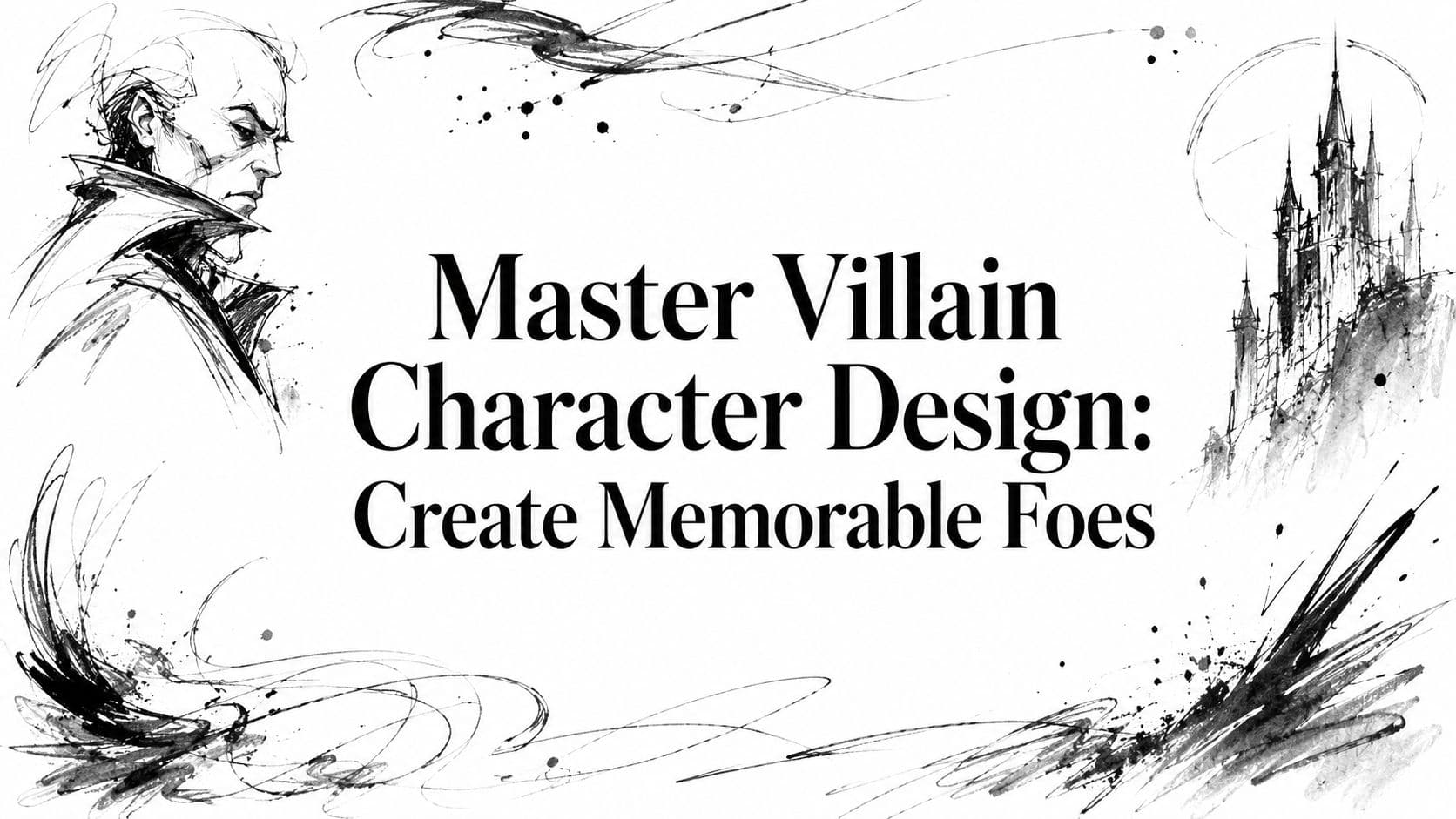
Most advice about villain character design starts in the wrong place. It starts with the coat, the scar, the voice, the weapon, the cool silhouette in the doorway.
That's backwards.
A villain that only looks dangerous is set dressing. A villain that wants something badly, believes they're justified, and carries that belief into every design choice can carry an entire story. The visual layer matters, but it has to be the surface expression of an inner logic. Otherwise you get a character who photographs well and collapses the moment they have to make a hard decision.
The strongest villains feel inevitable. Their appearance, speech, habits, and methods all come from the same source. That's the true work of villain character design in 2026. Not making someone “evil enough,” but making them coherent enough that every scene with them feels charged.
Why Your Villain Is Your Most Important Character
The hero gets the arc people talk about. The villain creates the pressure that makes that arc happen.
A weak protagonist can sometimes be rescued by a strong premise. A weak villain almost always drags the whole story down. If the antagonist doesn't force difficult choices, the plot turns into errands. If they don't attack the story's core values, the conflict stays shallow no matter how many explosions you add.
That's why I push back on the usual “focus on your protagonist first” advice. In practice, the villain often tells you what your story is about. They define the stakes. They expose the hero's blind spots. They turn abstract themes into concrete threats.
A good villain doesn't just oppose the hero. They make the hero's current way of living impossible.
That expectation for depth didn't appear out of nowhere. As a relevant overview on the evolution of villain design notes, villain portrayal shifted from simplistic monsters toward psychologically nuanced antagonists, with the mid-20th century marking a major turn and characters like the Joker helping set a standard for villains who were flawed, emotionally resonant, and more than plot devices.
That change matters for creators. Audiences don't just want menace anymore. They want intent. They want contradiction. They want a villain who seems capable of existing off-screen, making choices for reasons that make terrible sense to them.
What the villain really controls
A strong villain shapes three things better than any other character:
- The kind of conflict your story has. Political, intimate, ideological, survival-driven, tragic.
- The kind of growth your hero needs. Courage, restraint, honesty, mercy, sacrifice.
- The emotional texture of the world. Paranoia, dread, temptation, grief, seduction.
If your draft feels flat, I'd look at the villain before I touch the hero. Most of the time, the problem isn't that the protagonist lacks personality. It's that nobody in the story is applying pressure in a way that matters.
Beyond Evil and Defining Motivation and Backstory
The cleanest way to ruin a villain is to label them “evil” too early. Once you do that, you stop asking useful questions.
A villain works when they have a self-justifying worldview. They may be cruel, delusional, arrogant, or broken. But in their own mind, they're solving a problem. If you can't write the argument they'd make in their own defense, you probably don't know them yet.

If you need a starting framework, I like to think in motives first and biography second. Backstory should explain the worldview, not drown it in trivia. A useful way to build that foundation is to draft the character's private history with a structured prompt, like this character backstory template, then cut everything that doesn't affect present behavior.
Ideology first
Some villains are convinced the world is broken and only they have the nerve to fix it.
This type is dangerous because they can sound persuasive. They don't need to be cackling tyrants. They can be reformers, zealots, technocrats, revolutionaries, or moral purists. Their horror comes from what they permit themselves to do in service of a principle.
What works:
- A clean belief with ugly consequences. “Order matters more than freedom.” “Truth matters more than kindness.”
- A moral hierarchy. They rank values, and human lives end up below the thing they worship.
- Visible consistency. They punish allies and enemies by the same standard.
What doesn't:
- Mushy slogans. If their ideology could fit on a coffee mug, it probably won't survive a scene.
- Random cruelty with intellectual wallpaper. Audiences can tell when “philosophy” is pasted on after the fact.
Trauma without turning pain into a shortcut
Trauma can explain a villain. It should not excuse lazy writing.
The common mistake is using suffering as a substitute for personality. Someone who was hurt doesn't become compelling by default. The interesting question is what false conclusion they built from the hurt. Maybe they learned that love provides power. Maybe they decided vulnerability is a trap. Maybe they now believe domination is the only safe position.
Practical rule: Don't ask, “What happened to them?” Ask, “What rule did they invent to survive it?”
That invented rule is where the character lives. It affects who they trust, what they fear, how they punish, and what kinds of weakness they cannot tolerate in others because it reminds them of themselves.
Necessity-driven villains
These are often the most unsettling because they don't look theatrical at first glance. They're cornered. They're desperate. They think every available option is bad, and they choose the one that harms other people first.
A necessity-driven antagonist can be a parent protecting a child, a leader trying to keep a city fed, a scientist hiding a disaster they caused, or a criminal who crossed a line and now keeps crossing it to avoid collapse. The power here is escalation. One compromise creates the next.
This type falls apart when the pressure feels fake. If the character has easy alternatives you're ignoring, the audience won't buy them.
Try writing a single paragraph in the villain's voice using this prompt:
- What am I protecting
- What am I willing to destroy to keep it
- Why would a weaker person call me monstrous
- Why are they wrong
If that paragraph reads like a real defense instead of a writer's summary, you've got something solid.
Crafting Flaws and Strengths for Believability
Invincible villains kill suspense. If the audience can't imagine how this person could ever lose, the story stops being tense and starts feeling rigged.
The answer isn't a hidden weak spot that appears in the final act. The answer is usable imperfection. A believable antagonist wins because they're formidable, but they remain vulnerable in ways that grow out of who they are.

Tactical flaws
These are mistakes in method. They make plans that look smart until pressure exposes the weakness.
A tactical flaw might be overconfidence, contempt for amateurs, dependence on a single system, obsession with elegance, or refusal to delegate. These flaws are useful because they shape scenes. They affect timing, positioning, and decision-making. They create openings the hero can exploit without making the villain suddenly stupid.
Examples that usually play well:
- They optimize for control. So they can't adapt when chaos enters the room.
- They overread the board. Brilliant strategist, terrible judge of ordinary human loyalty.
- They script outcomes too tightly. They win rehearsed conflicts and fumble improvised ones.
What usually plays badly is the genius villain who keeps making obvious errors just so the plot can move. If the antagonist is supposed to be dangerous, let their competence stay visible even when they fail.
Emotional flaws
These are deeper and usually more memorable. They don't just affect tactics. They affect identity.
A villain may need recognition from a parent figure, remain loyal to one person who doesn't deserve it, fear humiliation more than death, or cling to an old grievance that distorts every new choice. Emotional flaws create the moments audiences remember because they reveal the human fracture beneath the machinery.
The best weakness is one the villain would describe as a virtue.
That's the trick. Devotion can become blindness. Pride can become isolation. Conviction can become fanaticism. If the flaw feels like the shadow side of a real strength, it lands.
Strengths that aren't just physical power
A lot of amateur villain design tops out at “very strong” or “magic but worse.” That gets old fast.
Give your antagonist strengths that shape social and narrative pressure:
| Strength | Why it works | Common misuse |
|---|---|---|
| Charisma | They can recruit, persuade, and split alliances | Writing them as loved by everyone for no reason |
| Patience | They can wait longer than the hero can endure | Making them passive instead of deliberate |
| Conviction | They don't bend when others would quit | Turning them into a slogan machine |
| Adaptability | They learn quickly and change tactics | Using it to erase consequences |
One of my favorite balances is this: make the villain hard to beat in public, but fragile in private. Or reverse it. Some villains can command a room and collapse when confronted with intimacy. Others are terrifying one-on-one and surprisingly weak as leaders.
That contrast gives you range. It also keeps the villain from becoming a single-note machine.
Designing the Look and Sound of Evil
Now you earn the visual side.
The biggest mistake in villain character design is decorating before defining. If you start with details, you usually end with clutter. Start broad. Lock what reads from a distance. Then move inward.
Industry guidance on top-down character design puts it plainly: establish the silhouette first, choose 2–3 consistent shape languages, and iterate thumbnail versions before committing to interior detail. That advice holds up because silhouette is still the fastest read a character gets.

Start with silhouette and shape language
If I blur your design down to a black shape, can I still tell who this person is?
That's not an art-school exercise. It's a practical test. Distinct silhouette creates recognition before expression, costume texture, or rendering style can do any work. A villain with a rigid high collar, off-balance posture, and severe negative space around the body reads differently from one built like a compressed boulder.
Then choose a shape language and stay consistent. Triangles tend to feel aggressive, sharp, unstable, predatory. Squares feel imposing, immovable, authoritarian. Curves can read soft, deceptive, decadent, or alien depending on context.
Use two or three families of shapes, not ten. Mixed signals make muddy designs.
Which cues matter most
A useful empirical anchor comes from a study of video-game antagonists. It found that head, body, and presentational cues were the strongest predictors of perceived villainy, with a final model explaining R^2 = 0.669 of morality judgments. The strongest individual predictors were mouth (β = 0.19), skin problems (β = 0.43), stance (β = 0.22), and weapon presence (β = 0.21) in the Frontiers study on antagonist perception.
That lines up with practice. Designers often overinvest in costume trim and underinvest in the mouth, posture, and how the character occupies space. A mouth set in a permanently strained smile, a jaw held too still, or a stance that suggests ownership rather than readiness can do more than another layer of armor.
Here's where I'd focus first:
- Mouth. Tight control, hunger, contempt, false warmth, mania. It's all there.
- Stance. Forward pressure, collapse, theatrical openness, guarded precision.
- Weapon presence. Not just whether they have one, but how naturally it belongs to them.
- Surface condition. Skin, scarring, grooming, polish, decay. This changes the read immediately.
Don't ask whether a design looks “cool.” Ask what judgment the audience forms in the first second.
Color and verbal design
A lot of villain palettes lean on dark tones by reflex. Sometimes that works. Sometimes it's lazy.
The more useful principle is controlled contrast. The research on visual design of villains and heroes notes that villainous characters were more likely to be humanoid than heroic ones, with 18% of villains classified as humanoid compared to 7% of heroes, and it also highlights associations between villain perception and visual traits such as exaggerated triangular forms, extreme facial expressions, and dark or muted palettes. That same source also references the 60-30-10 rule, where the dominant color covers most of the design, a secondary color supports it, and an accent creates a focal point.
Use that rule to direct attention, not to follow a formula blindly. If your villain is emotionally cold but politically polished, a restrained palette with one surgical accent can do more than full goth armor. If they're vain and theatrical, brighter contrast might be exactly right.
Verbal design matters just as much. Build speech from worldview.
A fast voice test
Try these questions out loud:
- Do they speak to persuade, dominate, confess, or perform
- Do they use precise words or loaded ones
- Do they answer directly, or redirect
- What emotion do they refuse to show in public
A villain who speaks in calm administrative language feels different from one who speaks in prophetic imagery, even if both want the same outcome. The voice should feel like the spoken form of the visual design. Same logic. Same damage.
For physical description copy, I often draft one clean reference paragraph first. If you need examples of what that looks like on the page, this example of a character description is a useful reference point.
The Villain's Relationship with Your Hero
A villain in isolation is just a character study. A villain in relation to the hero becomes a story.
The strongest antagonist dynamics don't depend on simple opposition. They depend on pressure at the level of identity. The villain should threaten not just the hero's safety, but the hero's beliefs, methods, loyalties, or self-image.
Four dynamics worth stealing
Some pairings generate conflict almost automatically.
Dark mirror works because the villain reflects the path the hero could take under different choices. This is usually strongest when the similarity is moral, not cosmetic. Shared wound. Shared talent. Opposite line.
Disappointed idealist hits when the villain once believed in the same cause but chose brutality when progress felt too slow. That gives every argument weight because the villain knows exactly where the hero's values are weak.
Intimate betrayer turns plot into scar tissue. Former mentor, sibling, partner, friend, commander. The villain already knows where to cut.
Necessary enemy is quieter but often richer. The hero and villain may both want legitimate things that cannot coexist. Nobody is lying. Nobody can back down.
If your villain could be swapped into another story without changing the hero, the relationship isn't specific enough yet.
Villain-hero dynamics
| Dynamic | Core Conflict | Subversion Idea |
|---|---|---|
| Dark mirror | The villain embodies the hero's worst possible future | The hero is actually harsher, and the villain sees that first |
| Disappointed idealist | Shared goal, irreconcilable method | The villain is right about the problem but wrong about what it costs to solve |
| Intimate betrayer | Trust has curdled into personal war | The betrayal was partly engineered by the hero's earlier failure |
| Necessary enemy | Both sides want survival, justice, or stability, but their needs collide | They can cooperate briefly, which makes the final break hurt more |
How to avoid the obvious version
Writers often stop at the label. “They're foils.” Fine. But in what scene does that hurt?
A dark mirror dynamic needs a moment where the hero recognizes themselves in the villain and hates it. A betrayer dynamic needs history that still shapes current choices. A disappointed idealist needs arguments sharp enough that the hero can't dismiss them with moral superiority.
Three practical checks help:
- Give them one shared language. A phrase, ritual, doctrine, joke, or training habit.
- Make the villain attack a value, not just a target. Mercy, faith, duty, family, truth.
- Let the hero win the external fight and still lose something internal. Certainty, innocence, reputation, trust.
That's where the relationship stops being decorative and starts carrying emotional weight.
Bringing Your Villain to Life with AI Tools
Once the inner logic and outward design are in place, the next challenge is iteration. Most villains look good in notes and fall apart in scenes.
That's where AI tools are useful. Not because they replace judgment, but because they speed up pressure-testing. You can prototype backstory, rewrite dialogue, simulate confrontations, and spot inconsistency before it hardens into canon.

A workflow that works looks like this:
Use AI for variation, not authority
Start with a tight prompt built from the pieces above. Motivation. False belief. Strength. Flaw. Public mask. Verbal style.
Then ask for variations that stress the character from different angles. Give me the courtroom version. The private confession. The recruitment pitch. The scene where they lose control. You're not asking the model to invent the truth of the character. You're asking it to show you where the concept bends or breaks.
For visuals, a separate image tool can help with fast surface exploration. If you want rough visual ideation before handing things to an illustrator or refining them yourself, free AI character creation for games can be useful for testing costume directions, props, and mood without committing too early.
Test continuity in actual scenes
Many creators stop too soon. They make a profile and call the character done.
Instead, run your villain through repeated situations. Interrogation. Seduction. Defeat. Public speech. Loss of a lieutenant. Unexpected kindness from the hero. If the voice and motives drift every time, the concept isn't stable yet.
That's one reason a story tool like Dunia's character consistency workflow is relevant here. The platform is built for creating interactive stories where you define characters, relationships, and plot, then test those personalities across branching scenes. For villain work, that means you can see whether the antagonist still feels like the same person when the story takes an awkward turn.
After you've got a written profile, it helps to watch another creator talk through design choices in motion:
AI is best at accelerating loops you already understand. It's bad at replacing taste. If your villain's motive is mushy, the tool will generate polished mush. If the concept is strong, the tool helps you push it harder, faster, and across more situations than you'd normally test by hand.
Build the villain manually. Break them with tools. Keep what survives.
If you want to turn a villain concept into an interactive story and see how they hold up against real choices, Dunia gives you a practical way to build the world, define the antagonist, and play through the consequences from inside the narrative.