Blog
Warhammer High Elves: A 2026 Guide to the Asur of Ulthuan
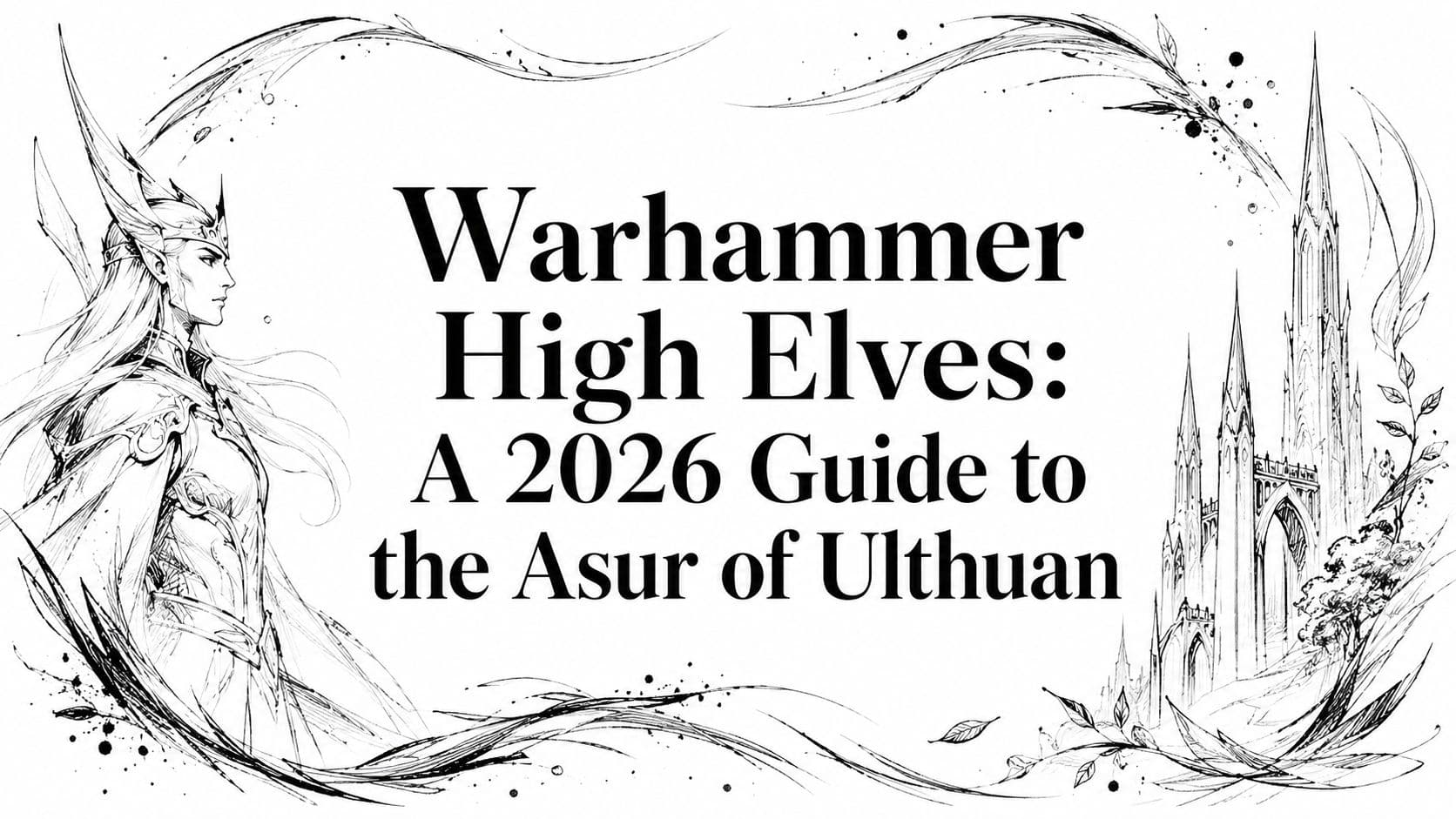
I watched a new player put High Elf spearmen on the table like they were just prettier Empire troops. Two turns later he understood the essence of the Asur. They aren't just elegant. They're brittle, proud, magical, and built around doing the right thing at exactly the right time.
An Introduction to Doomed Perfection
The Warhammer High Elves, or Asur, are one of those factions that look simple from a distance and get stranger the closer you get. On the surface, they're the classic shining elf kingdom. White towers. Gold helms. Princes on dragons. Scholars who can bend the world with a gesture. That image is real, but it isn't the whole truth.
What makes them stick in your head is the contradiction. They feel ancient and immaculate, but they also feel exhausted. Every banner, every polished suit of scale armor, every perfect formation carries the sense that this is a people holding themselves together through discipline and memory more than joy.
They belong to the oldest kind of fantasy tragedy. A civilization that still looks magnificent while bearing too much grief, too much duty, and too much certainty that only it understands what must be done. That's why “noble elf” barely covers it. The Asur aren't interesting because they're nice. They're interesting because they believe they have to be better than everyone else, and often act like it.
Why they stand out
A lot of factions in Warhammer have a strong gimmick. The High Elves have a full personality.
- They embody control: Their armies, rulers, and mages all revolve around restraint, precision, and timing.
- They carry history badly and beautifully: Their glory never comes free. It always drags old mistakes behind it.
- They make virtue complicated: They fight dreadful enemies, but they can still be condescending, manipulative, and cold.
The best High Elf stories work when admiration and irritation happen at the same time.
That's the sweet spot. If you only read them as pure heroes, they get flat. If you only read them as pompous tyrants, you miss the tragedy. The fun is in the tension between those two readings.
The Soul of Ulthuan and the Winds of Magic
If you want to understand the Asur, start with Ulthuan. Their homeland isn't just a pretty map location. It's the machine that shapes their culture.
The High Elf civilization is defined by the island-continent of Ulthuan, ringed by ocean and protected by ancient wards of magic, which gives them a closed and sacred homeland and feeds their belief that they are the rightful stewards of the world chosen to stand against Chaos, as described in this High Elf lore overview at Fables.

That matters because environment becomes mindset. If your whole civilization is built around protecting a magically sheltered homeland and maintaining a sacred duty against Chaos, you won't grow into a relaxed, easygoing people. You'll grow into guardians. Then into elitists. Then into guardians again.
Why Ulthuan makes them arrogant
Other races see High Elf arrogance and assume it's just vanity. Sometimes it is. But there's a harder edge beneath it.
The wards around Ulthuan create a culture where responsibility never switches off. The Asur don't think of themselves as one kingdom among many. They think of themselves as a civilizational anchor. That doesn't make them morally right. It does explain why they talk down to everyone else.
A practical way to read them is this:
| Element | What it does | What it costs |
|---|---|---|
| Sacred homeland | Gives the Asur identity and continuity | Encourages isolation |
| Ancient wards | Reinforces the duty to oppose Chaos | Turns duty into superiority |
| Long memory | Preserves culture and discipline | Makes forgiveness rare |
That trade-off is the whole faction. Their discipline is impressive. Their self-regard is hard to tolerate. Both come from the same place.
Why their magic feels different
The second pillar is magic. Not generic fantasy magic. Warhammer magic, with all the danger and hierarchy that implies.
The High Elves possess a unique biological and magical advantage because their long lifespans allow gifted individuals to master multiple winds of magic, unlike human wizards who typically use only a single form, according to this lore discussion on YouTube. The same source also notes they have a natural resistance to disease and physical mutations caused by Chaos, though they remain vulnerable to Nurgle's Rot.
That single idea explains a lot.
- Their mages feel older in every sense: They don't just know spells. They cultivate mastery across forms of magic over immense spans of time.
- Their society respects control above impulse: Magic in Warhammer punishes recklessness. Elves who survive long enough to master multiple winds become proof that patience wins.
- Their superiority complex gets fuel from real ability: This is important. Their arrogance isn't baseless posturing. They often are more refined, more disciplined, and more magically capable.
Practical rule: When writing or playing High Elves, treat magic as culture, not just firepower.
That's why the Warhammer High Elves feel so distinct. Ulthuan gives them the burden. Longevity gives them the tools. Put those together and you get a civilization that can seem majestic, unbearable, and necessary all at once.
Are High Elves Actually the Good Guys
This is the question that hooks people once they get past the shiny armor. Are the High Elves heroes, or are they just a polished version of the same old imperial arrogance?
The honest answer is that they're neither simple saints nor straightforward villains. They defend the world from real horrors. They also treat many other peoples with suspicion or outright disdain. That tension is part of the design, not a flaw in the lore.

A useful community snapshot of that debate shows up in this Reddit discussion asking whether High Elves are supposed to be bad. The central point behind the argument is familiar to anyone who's read the faction seriously. High Elves are often framed as defenders, but they're also presented as suspicious of, if not degrading to, other factions.
The case for them being good
There's a reason people default to “good guys.”
They oppose Chaos. They preserve knowledge. They maintain ancient responsibilities that other races either can't handle or don't even understand. If the world survives another age, the Asur usually had a hand in that survival.
They also fit an old heroic mold. Ordered armies. learned mage-lords. rulers who believe duty matters more than comfort. In broad fantasy terms, that reads as noble.
The case against them
The problem is that nobility in Warhammer always comes with teeth.
The High Elves can be aloof to the point of cruelty. They often assume they know better than humans, dwarfs, or anyone else in the room. They don't merely preserve their culture. They rank it above others. That creates stories where they may be correct about the danger and still insufferable about the solution.
A lot of newcomers miss this and flatten them into bright-side elf propaganda. That version is boring.
They can save your city and still leave you feeling insulted by the rescue.
That edge matters even more when you remember the broader elven split. The mortal world has three main kindreds of Elves: the High Elves or Asur, the Dark Elves or Druchii, and the Wood Elves or Asrai, as summarized in this Warhammer Elves overview. All are described there as tall, slender humanoids, naturally magical, and long-lived members of the Eldest Race.
Why the flaws make them better
The split between those kindreds tells you everything. Elven civilization didn't produce one stable moral ideal. It fractured. That means pride, violence, isolation, refinement, and obsession were always in the blood somewhere.
For creators, this is gold. A High Elf noble isn't compelling because she's wiser than everyone else. She's compelling because she might be wiser than everyone else and still fail through pride. An Asur prince can be brave and unbearable at the same time. A mage can protect the world while believing ordinary lives are too brief to matter much.
That's why the “bad guys” question is a little too neat. The High Elves are more interesting than that. They're a civilization trying to justify its arrogance with genuine service, and sometimes succeeding.
Faces of the Phoenix Throne
You don't really understand the Asur through army lists or timelines. You understand them through the kinds of people they produce.

Tyrion and Teclis
Tyrion and Teclis are the classic pair for a reason. One is the image of martial brilliance. The other represents magical genius bound up with frailty and burden. Together they show what High Elf excellence looks like when it splits into blade and mind.
Tyrion is the dream the Asur sell to themselves. Heroic strength, presence, certainty, battlefield authority. Teclis is the harder truth. Knowledge has a cost. Power often sits in a body or a life that can't carry it cleanly.
That pairing is old Warhammer at its best. High glory, high pressure, and no easy emotional balance.
Alith Anar and the shadow side
Then you get Alith Anar, and the faction takes a darker turn.
Alith Anar, the Shadow King, serves as a unique Legendary Lord for the High Elves in Total War Warhammer 2 and was presented as one of the most logical and unique characters for that role in this YouTube discussion of his faction potential. He matters because he represents an Asur answer to suffering that isn't noble pageantry. It's vengeance. Ambush. Patience sharpened into hatred.
He's one of the best reminders that High Elves can be elegant without being soft.
Later strategy talk around support units helps underline that shadow-war identity too. One analysis points out that Shadow Stalker scouts are “really key to maximizing” certain champions, which fits Alith Anar's whole style of indirect pressure and careful positioning.
What these characters actually show
The point isn't memorizing names. It's seeing the range inside the faction.
- Tyrion shows the idealized protector.
- Teclis shows intellect carrying more than it should.
- Alith Anar shows what happens when grief becomes method.
If you're building your own Warhammer High Elves characters, borrow that internal tension. Don't make them all radiant nobles. Make one too proud to apologize. Make another disciplined enough to seem cold. Make a third who serves the light by fighting like a ghost.
The Asur at War A Symphony of Spear and Sorcery
On the table, High Elves punish sloppy thinking. That's true in miniature wargaming, in adaptation, and in strategy games. Their warfare is about layered timing. A line holds. Archers strip key threats. Magic tilts the exchange. Then elite pieces exploit the opening.
If you try to run them like a blunt-force faction, they'll disappoint you. If you respect their sequencing, they feel surgical.
What usually works
The classic High Elf battle plan starts with discipline. Spear units and other steady infantry don't need to be glamorous. They need to anchor the fight long enough for the rest of the army to matter. Archers and mages then do the elegant work. You don't win because one piece is absurd. You win because every piece supports the next.
In Total War Warhammer 2, High Elves also get frontline support abilities such as Foe-seeker, Deadly Onslaught, and Stand You Ground, and one Steam guide compares their overall campaign feel to the Empire because of trade potential and nearby factions of the same race in that game's setup, as described in this High Elf campaign guide on Steam Community.
That comparison is useful, but only to a point. The Empire often feels adaptable and improvised. The Asur feel curated. Their roster rewards players who commit to spacing, target priority, and protecting valuable tools.
The support units people ignore
Many players often leave value on the table. They obsess over famous elites and forget the less obvious units that make the army sing.
The best example is Shadow Stalkers. That same analysis shown earlier argues they're “really key to maximizing” certain champions, yet many mainstream race guides barely explain their positioning or their scouting role. That gap matters. These units aren't there to win a frontal grind. They're there to create uncertainty, bait responses, pressure flanks, and let your premium pieces hit under better conditions.
Use them badly and they feel wasted. Use them well and they change how your opponent moves.
Battlefield habit: Don't ask whether a support unit kills enough. Ask whether it makes your best unit safer, earlier, or freer.
For anyone writing combat scenes inspired by this style, this guide to writing battle scenes is useful because it emphasizes flow, positioning, and cause-and-effect rather than just listing attacks.
What doesn't work
A few mistakes show up over and over:
- Overextending elite units: High Elves look regal enough that players assume they can just shove forward. Bad idea.
- Wasting magic on low-value moments: Their magical ceiling is part of the faction fantasy. Don't spend it on trivia.
- Ignoring morale and tempo: The Asur often win by keeping a beautiful plan intact. Once the plan cracks, expensive units can start feeling fragile.
That's the military identity in one line. Precision first. Vanity second. If you reverse those, the army falls apart.
Starting Your Own Shining Host
Collecting High Elves is one of the most satisfying hobby projects in Warhammer because the aesthetic is so readable. Clean armor panels. Tall helms. Spear lines. White, blue, crimson, gold. Even a simple paint scheme looks intentional if the trims are sharp and the cloth is neat.
The trap is trying to make them too pristine. A little wear, a colder palette, or a more regional heraldic choice often gives them more personality than parade-ground perfection.
Picking a look that suits the lore you want
Ask a basic question before you buy too much. Do you want your army to look like ceremonial defenders of Ulthuan, or survivors of a grim campaign? Both work. They just ask for different choices.
A quick way to decide:
| Style | Best for | Visual cues |
|---|---|---|
| Classic courtly Asur | Bright heroic look | White armor, blue cloth, gold trim |
| Shadow war host | Alith Anar influence | Darker cloaks, muted metals, colder bases |
| Weathered veterans | Tragic campaign tone | Dust, battle wear, restrained heraldry |
Easy wins for hobbyists
You don't need fancy conversion work to make the army yours.
- Swap head choices carefully: A helmet change can shift a unit from formal guard to frontier veteran.
- Use cloak color as identity: Keep armor consistent, then let cloth establish province, commander, or campaign history.
- Base them with intent: Marble, coastal stone, ash, or moonlit forest all tell different stories before a model rolls a die.
For rules-minded players, lore-minded players, and anyone building custom units for home games, a stat block maker for fantasy characters and creatures can help organize your custom ideas before they sprawl.
Painting the magical side of the faction
The Asur also reward a little visual storytelling in the details. Gems, runes, banners, and spell effects carry a lot of the faction's identity. If you paint every model as just clean armor and bright cloth, you'll miss half the mood.
This lore video is also a useful hobby reference because it reinforces the magical and biological distinctiveness that should show up in how you paint your leaders and mages.
The practical takeaway is simple. Paint them like people who have carried responsibility for an impossibly long time. Even the bright schemes should look deliberate, not cheerful.
Writing Your Own Elven Saga
High Elves work best in fiction when you resist the urge to make them spotless. Give them duty, then make that duty expensive. Give them wisdom, then let pride distort it. Give them beauty, then put it under pressure.
That's what makes them useful for original storytelling in 2026. They carry built-in conflict. An Asur prince can't just win a battle. He has to decide whether protecting the world gives him the right to rule over people who never asked for him. A mage can't just be brilliant. She has to live long enough to become distant from ordinary grief.

Story hooks that fit the Asur
Some of the strongest High Elf-inspired story premises are small in scale.
- A noble envoy who's trying to save a human city he barely respects
- A shadow warrior whose revenge is starting to outlive its purpose
- A court mage forced to choose between prophecy and mercy
Those stories work because the faction is already built on contradiction. Grandeur on the outside. strain on the inside.
If you're building a workflow for original fantasy writing, this piece on AI for content creation workflow is a useful companion because it focuses on process and structure rather than hype. For turning faction themes into your own setting, a solid fantasy worldbuilding template also helps keep cultures, conflicts, and character motives aligned.
High Elf-inspired fiction gets better the moment you stop asking who is pure and start asking who is burdened.
That's the core lesson of the Asur. They aren't compelling because they're the best version of elves. They're compelling because they're a proud people trying to earn the right to their own self-image, and often failing in ways that feel painfully human.
If this kind of morally messy, character-first fantasy is your thing, try building your own interactive story on Dunia. It's a strong fit for branching sagas about pride, duty, betrayal, and impossible choices, especially when you want recurring characters to stay consistent across a long arc.